STADIA ART · A CLOSER LOOK
Art
through time.
Look closely.
Understand how it was made.
Explore monuments, sculpture and painting through the decisions that shaped them: materials, structure, technique and meaning. Start with an image, then look beneath its surface.
Explore the collection ↓ Understand the techniques →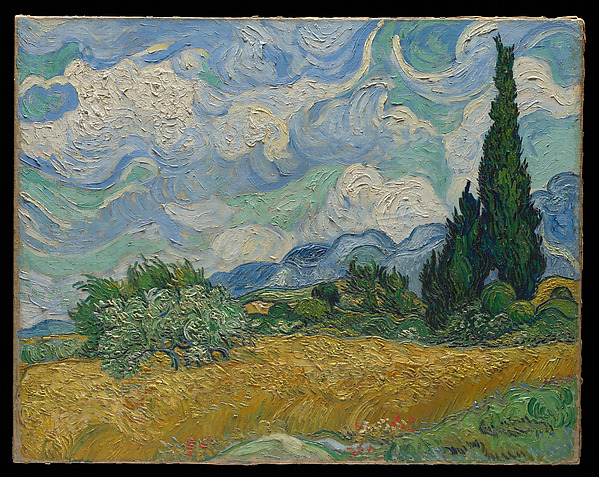
Vincent van Gogh, 1889
The Metropolitan Museum of Art, New York · CC0
Start with form, light and surface.
Connect materials, technique and context.
Compare your reading with the evidence.
NINE WORKS · THREE ROUTES
Explore the collection
Open a study for its historical context,
technical focus and further reading.
9 studies shown
Ancient art · Monuments & architecture
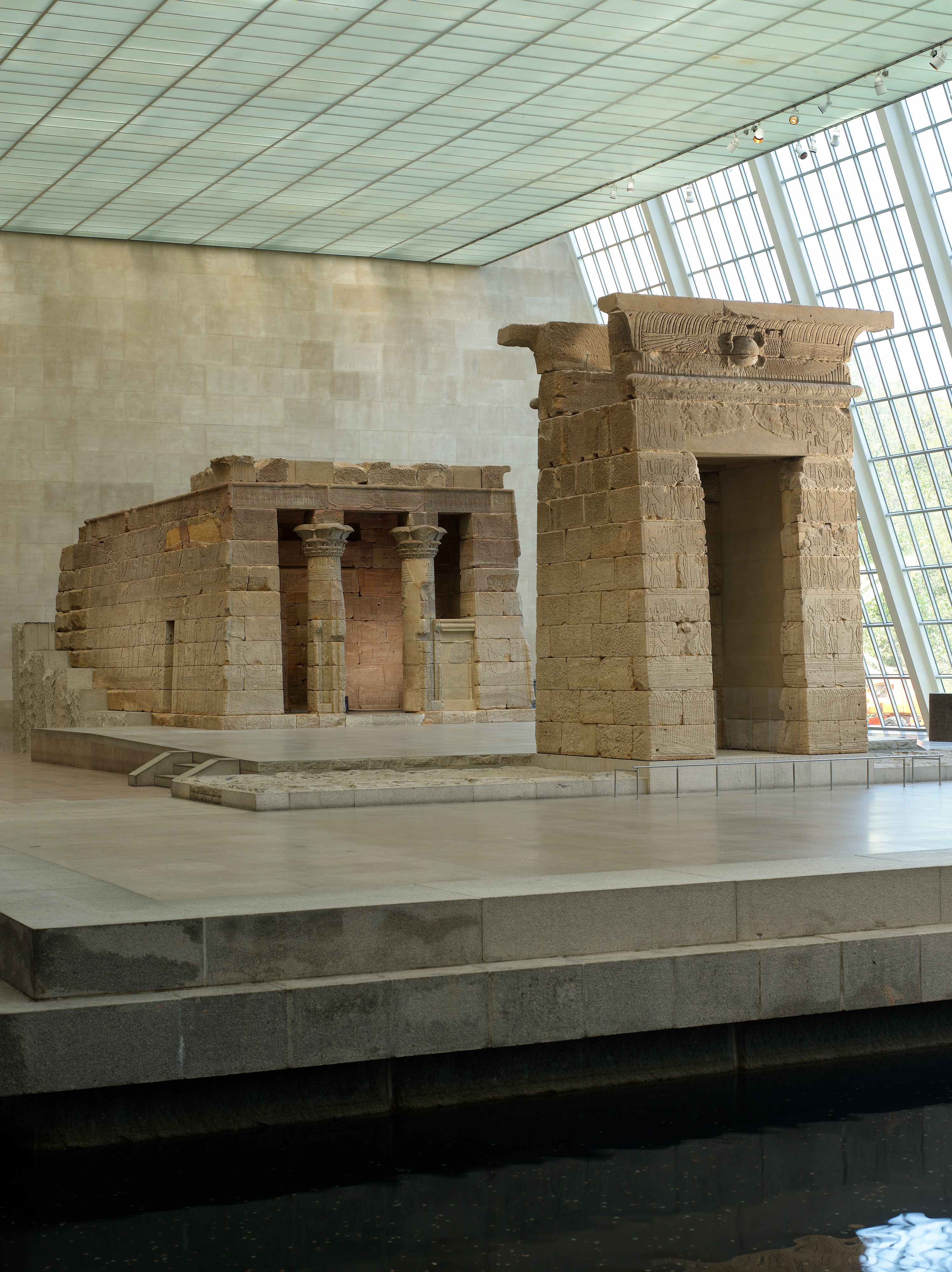
The Temple of Dendur
Builders working under the Roman emperor Augustus
Completed by 10 CE
Read a temple as a sequence of spaces, a stone structure and an image of the natural world.
Read the full studyClose this study
- Material
- Aeolian sandstone
- Scale / format
- Temple proper: approximately 6.40 m high × 6.40 m wide × 12.50 m long
- Place
- Originally Dendur, Nubia; now The Metropolitan Museum of Art, New York
History and function
Built under Roman rule in Nubia, the temple combines an Egyptian architectural language with imperial authority: Augustus appears in the role of pharaoh. It honoured Isis and the deified brothers Pedesi and Pihor. Its imagery connects political rule, ritual offerings and the maintenance of an ordered world. [1]
Structure: blocks, supports and an axial plan
The building uses local sandstone blocks. A columned entrance hall leads to two further rooms, culminating in the sanctuary. Reading this sequence from the sanctuary outward helps explain the route of a divine image during a procession. The plant-shaped capitals are structural elements and meaningful images at the same time. The present museum platform is a reconstruction in granite, not the original riverside setting. [2]
Technical focus: raised and sunk relief
In sunk relief, a figure's outline and modelling are cut into the stone surface; in raised relief, the surrounding stone is removed so the figure stands forward. Dendur uses both. The exterior carvings could exploit strong sunlight and sharp shadows, while raised relief inside remained legible in less direct light. Technique responds to where an image will be seen. [1]
Reading the decoration
Plants along the base, floral columns and celestial signs above connect the architecture to earth and sky. Follow the offering scenes horizontally, then compare their placement with the vertical arrangement of the building. This is a useful way to see how an image can belong simultaneously to a narrative and to an architectural system. [1]
Evidence and reconstruction
The reliefs were originally coloured. The surviving stone and the museum installation should therefore be distinguished from a complete ancient appearance. Details of the temple's former enclosure and some ritual arrangements remain reconstructions or interpretations. The date above follows the museum's current collection record. [2] [1]
References and further reading
Image: The Metropolitan Museum of Art, New York · CC0. Museum Open Access photograph. Displayed at preview resolution; no content edits.
Ancient art · Sculpture
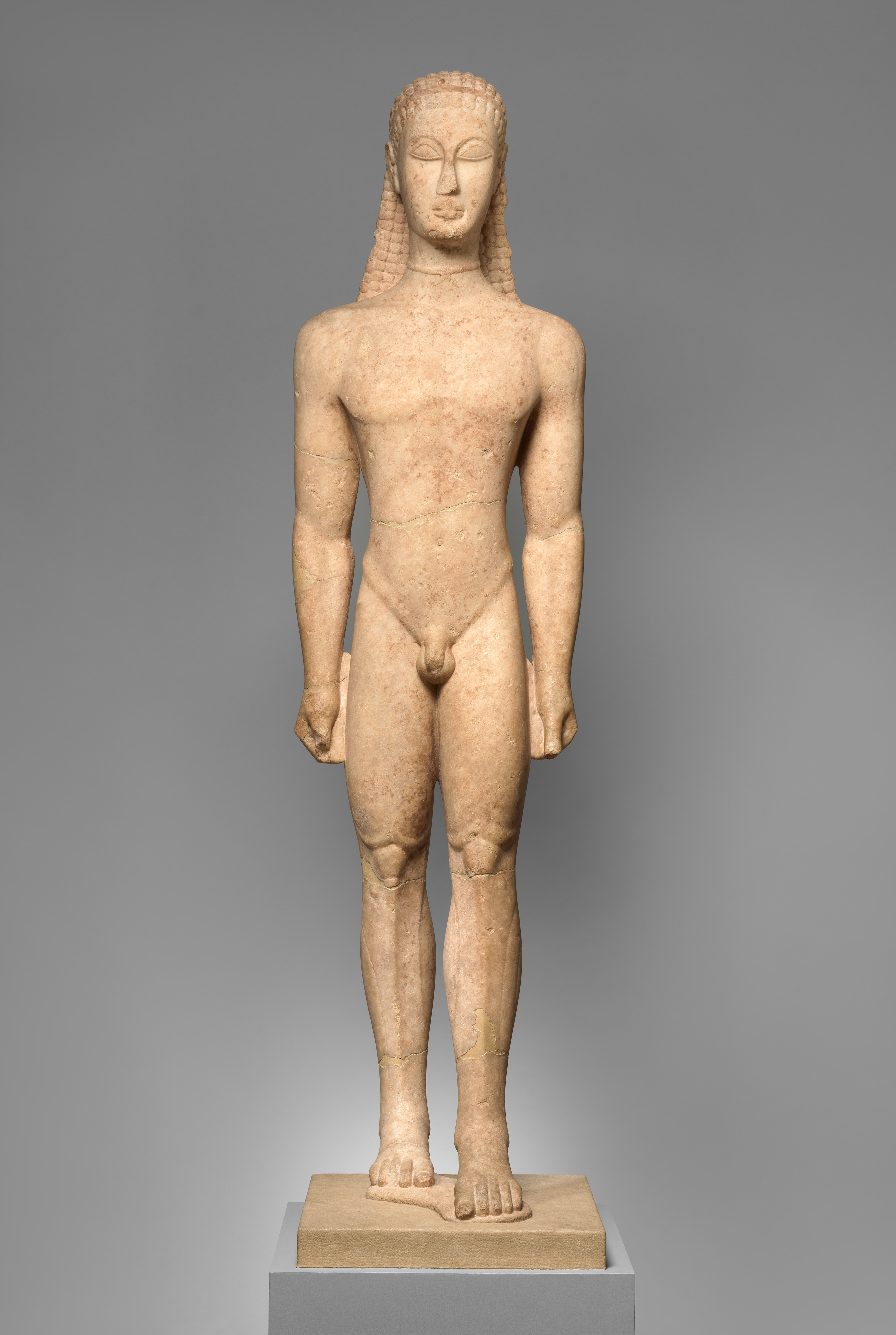
Marble statue of a kouros
Unknown Attic sculptor
c. 590–580 BCE
Understand frontal design, stylised anatomy and the difference between surviving marble and an original surface.
Read the full studyClose this study
- Material
- Naxian marble
- Scale / format
- Height: 194.6 cm
- Place
- Attica, Greece; now The Metropolitan Museum of Art, New York
History and purpose
This early Attic kouros marked the grave of a young Athenian aristocrat. The standing, frontal figure draws on an Egyptian pose, with the left leg advanced and the arms close to the body. The sculptor organised the human form through repeated geometric patterns rather than the varied muscular responses of a moving body. [3]
Technical focus: carving and the remaining mass
Stone carving is subtractive: the form emerges as material is removed. Here, compare the broad planes of the torso with the more closely articulated hair and knees. As an exercise in visual analysis, trace the silhouette and the spaces between the limbs. Consider how a sculptor must coordinate these views while retaining enough stone to support projecting parts.
Pose and the distribution of weight
An advanced foot does not automatically make a figure look as though it is walking. In this example, the shoulders remain level and the torso strongly frontal. Compare these features with the shifting hip line in Lombardo's Adam. That comparison helps distinguish a formal stride from the contrasting loaded and relaxed sides associated with contrapposto. [3] [10]
Polychromy and scientific investigation
Ancient Greek sculpture was frequently coloured. Research on surviving pigments uses close examination and analytical imaging; the Met's Chroma project also discusses material analysis and the limits of reconstruction. Evidence from the wider tradition does not establish the complete original palette of this individual statue. A reconstructed colour scheme must explain which areas are supported by surviving traces and which are interpretative. [4]
A guided comparison
Look first at the silhouette, then the kneecaps, abdomen and repeated locks of hair. Ask which forms describe a body and which create a rhythm across the stone. This is a viewing exercise, not a claim that the sculptor was trying and failing to achieve later naturalism.
References and further reading
Image: The Metropolitan Museum of Art, New York · CC0. Museum Open Access photograph. Displayed at preview resolution; no content edits.
Ancient art · Painting
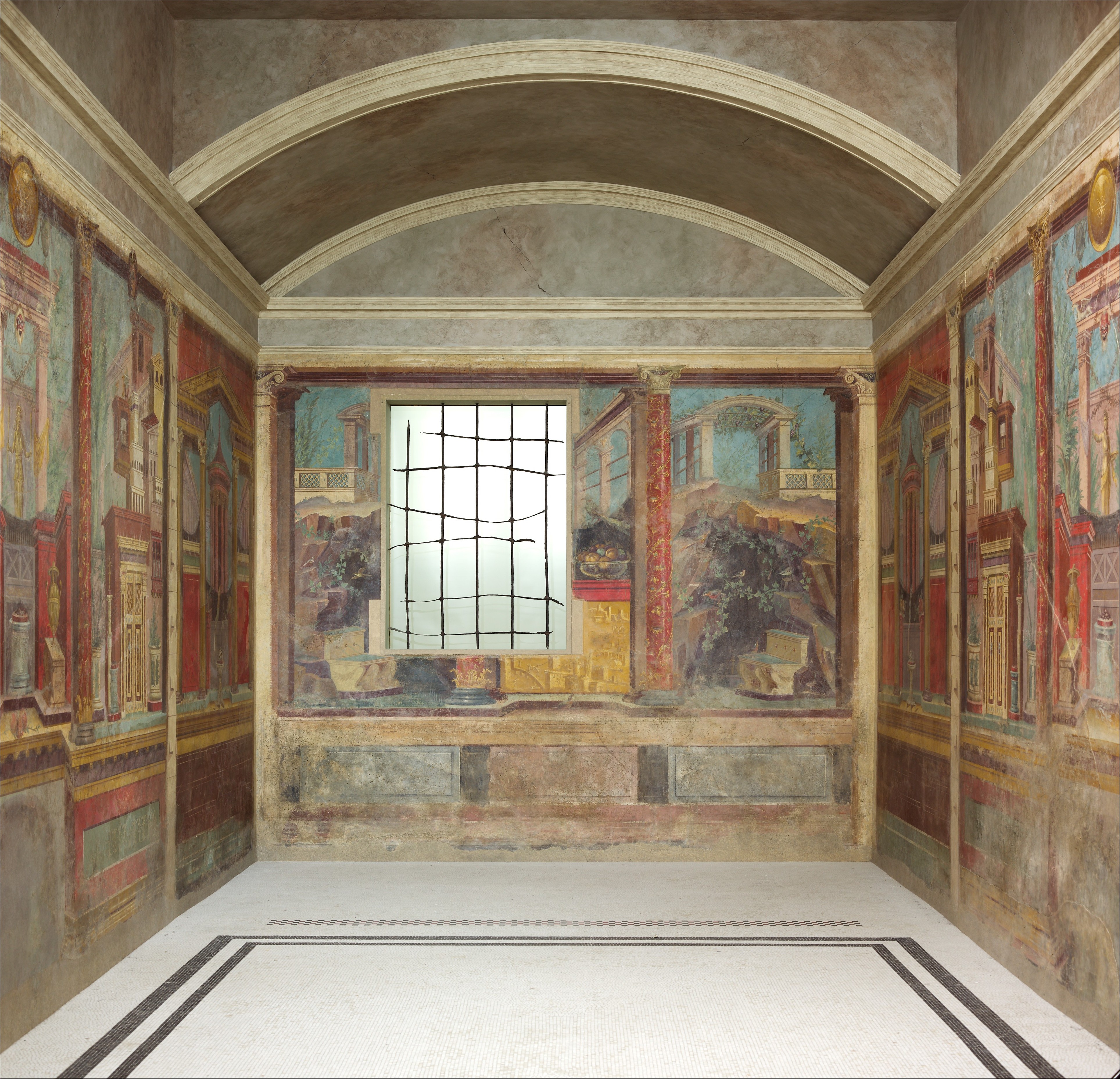
A painted bedroom from Boscoreale
Roman painters, names unknown
c. 50–40 BCE
Follow the chemistry of fresco and the visual devices that turn a wall into an imagined view.
Read the full studyClose this study
- Material
- Fresco on plaster
- Scale / format
- Room M, a cubiculum (bedroom)
- Place
- Villa of P. Fannius Synistor, near Pompeii; reconstructed at The Metropolitan Museum of Art, New York
History and setting
Room M belonged to a Roman villa buried in the eruption of Vesuvius in 79 CE. Its painted decoration predates that event by more than a century. The room functioned as a bedroom, and the surviving paintings are now displayed in a reconstructed setting. Their architectural imagery includes columns, courtyards, terraces and glimpses of landscape. [5]
Technical focus: what makes fresco different?
In buon fresco, pigments dispersed in water are applied to fresh lime plaster. As calcium hydroxide reacts with carbon dioxide, calcium carbonate forms and fixes colour into the surface. This differs from secco painting, applied to dry plaster with a suitable binding system. This general distinction explains the technique; it does not establish the application method of every detail in this room. [7]
Second Style and architectural illusion
The Boscoreale paintings belong to the late Second Style of Roman wall painting. Painted masonry, columns, shadows and projecting objects encourage the eye to read an imaginary space beyond the actual wall. These effects helped a wealthy household display cultural refinement. They should be examined as sophisticated devices of illusion without assuming that every line follows a single Renaissance-style vanishing-point system. [6]
How to look: space in layers
Separate the real room from its painted architecture. Follow one column upward, find the implied ledge behind it, and then look for a more distant building or patch of sky. The effect relies on overlaps and changes in apparent depth. Compare the symmetrical arrangement of the side walls with the more concentrated view on the rear wall. [5]
What the photograph cannot tell us
Colour on a screen is not a pigment identification. Nor does a smooth-looking digital image reveal the full condition of the plaster. Technical questions about a specific passage need conservation documentation or examination of the object; the museum's related publications are the appropriate next step.
References and further reading
Image: The Metropolitan Museum of Art, New York · CC0. Museum Open Access photograph. Displayed at preview resolution; no content edits.

Renaissance · Monuments & architecture
Brunelleschi's Dome
Filippo Brunelleschi
1420–1436; lantern completed later
Investigate how two masonry shells, ribs and a carefully organised building process cover an immense space.
Read the full studyClose this study
- Material
- Stone and brick masonry; terracotta roof tiles; marble ribs
- Scale / format
- Internal span approximately 45.5 m; external diameter approximately 55 m
- Place
- Cathedral of Santa Maria del Fiore, Florence, Italy
The architectural problem
Brunelleschi had to roof an enormous octagonal opening within an existing cathedral. The main dome was built between 1420 and 1436. Its construction avoided a complete timber centring framework supporting the whole vault from below. This achievement depended on an organised system of masonry and construction methods, not a single isolated trick. [8]
Technical focus: a double shell
The dome has an inner shell and an outer shell separated by a space containing the access route. The Opera del Duomo's architectural model makes this arrangement easier to understand than an exterior photograph. A section cuts through a building to reveal its thicknesses and voids; an elevation shows its outside face. Compare the two kinds of representation before interpreting the visible outline. [9]
Ribs, brickwork and the path of forces
The octagonal form is articulated by ribs, while herringbone brickwork is part of the construction system. The outer surface is covered with terracotta tiles. The main dome, supporting drum and piers need to be read together. Masonry carries loads principally through compression, so the geometry and the restraint of outward thrust matter as much as the strength of an individual brick. [8]
What the visible monument includes
The white ribs guide the eye toward the summit. The lantern belongs to Brunelleschi's design but was completed after his death. The large Last Judgment on the inner vault is a later intervention, painted by Vasari and Zuccari in 1572–1579. Building structure and painted decoration therefore represent different phases. [8]
A study method
Sketch an octagon in plan, then draw two nested profiles in section without treating the sketch as measured survey data. Mark the space between them and the supports below. Use the museum's architectural model to correct your first assumptions: an exterior photograph alone cannot reveal the hidden construction. [9]
References and further reading
Image: PROPOLI87 / Wikimedia Commons · CC BY-SA 4.0. Photograph displayed at reduced resolution without cropping or content edits. The photograph retains the licence linked above.
Renaissance · Sculpture
Adam
Tullio Lombardo
c. 1490–1495
Read classical anatomy and Christian imagery, then examine conservation as a problem of materials and forces.
Read the full studyClose this study
- Material
- Marble
- Scale / format
- Height: 191.8 cm
- Place
- Originally the tomb of Doge Andrea Vendramin, Venice; now The Metropolitan Museum of Art, New York
History and meaning
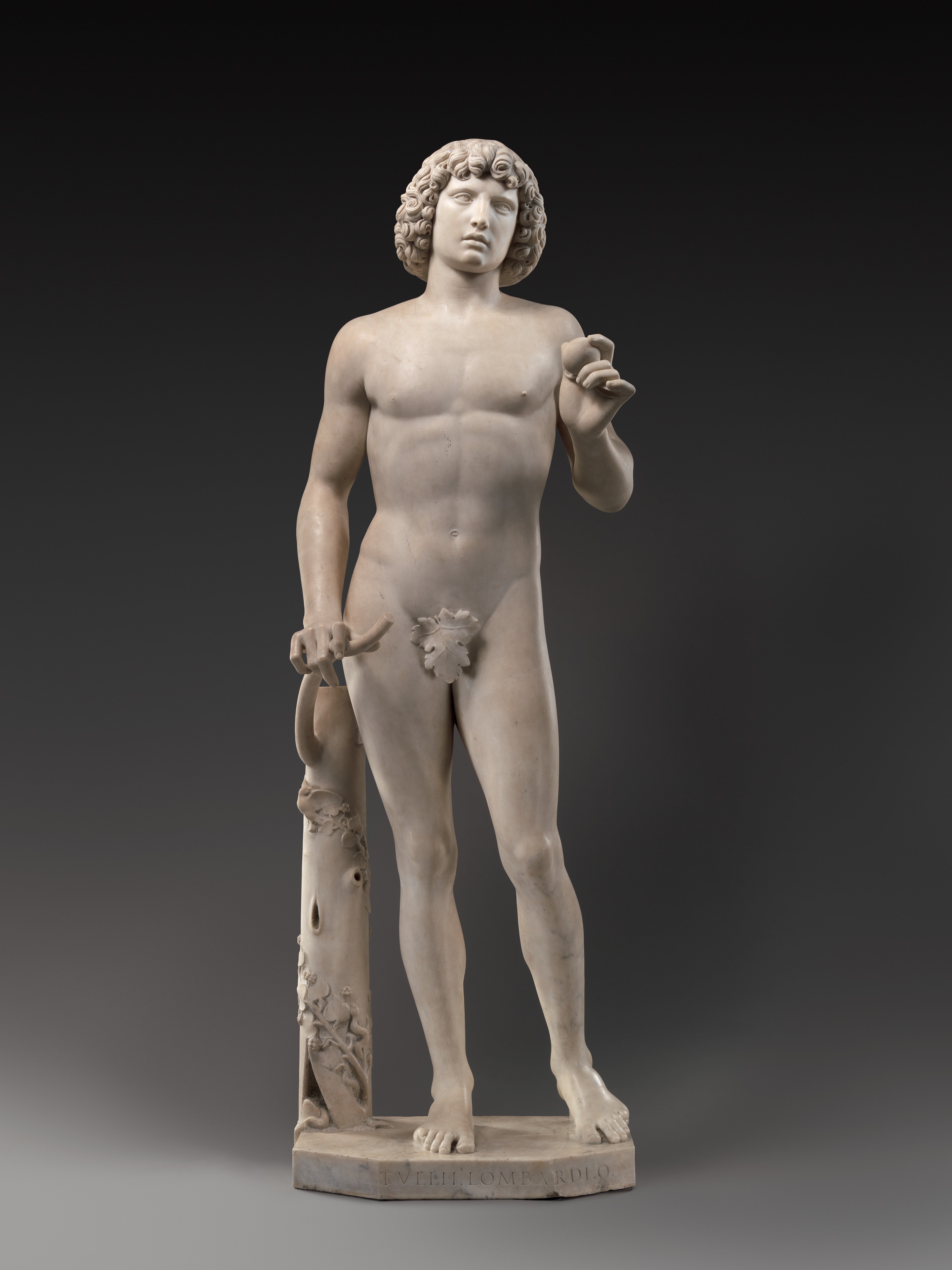
Adam was made for the tomb of Doge Andrea Vendramin in Venice. Lombardo brought classical figure types into a Christian funerary setting. The apple, serpent and vine connect the nude body to the Fall and Redemption. Its relationship with the tomb and a corresponding figure of Eve matters: it was not conceived simply as an isolated museum statue. [10]
Technical focus: carving a balanced body
The figure is carved in marble, with an unusually smooth finish. Look at the contrast between the supporting and relaxed leg, the responding hips and the quieter upper body. The adjacent tree trunk also links the anatomy to a substantial mass of stone. Reading both the pose and the material support prevents us from treating sculpture as a drawing that happens to be three-dimensional. [10]
Conservation: why the strongest repair is not always best
The published conservation study tested adhesives and reinforcing pins. Fibreglass rods were selected because their stiffness was more compatible with marble than the metal alternatives tested. An excessively stiff insert can transfer damaging stresses into the surrounding stone. The team also sought to minimise drilling: inserting a pin creates a new hole and therefore alters the original material. [11]
Reversibility and evidence
The research explored a sleeve system to make pinned joins more reversible. This shows why conservation is not simply a matter of finding a powerful glue: strength, stiffness, accessibility and future treatment all influence a decision. These results describe the documented restoration of this sculpture, not instructions for repairing another marble object. [11]
How to look
Move between the face, suspended hand and apple. Then compare Adam with the kouros in the ancient route: both are standing male figures, but their balance and expression are organised differently. Describe those visible differences before drawing conclusions about the people or beliefs represented.
References and further reading
Image: The Metropolitan Museum of Art, New York · CC0. Museum Open Access photograph. Displayed at preview resolution; no content edits.
Renaissance · Painting
The Harvesters
Pieter Bruegel the Elder
1565
Discover how an oak panel, oil paint and a constructed landscape turn seasonal labour into a complex image.
Read the full studyClose this study
- Material
- Oil on oak
- Scale / format
- Original painted surface: approximately 116.5 × 159.5 cm
- Place
- The Metropolitan Museum of Art, New York
Patronage and subject
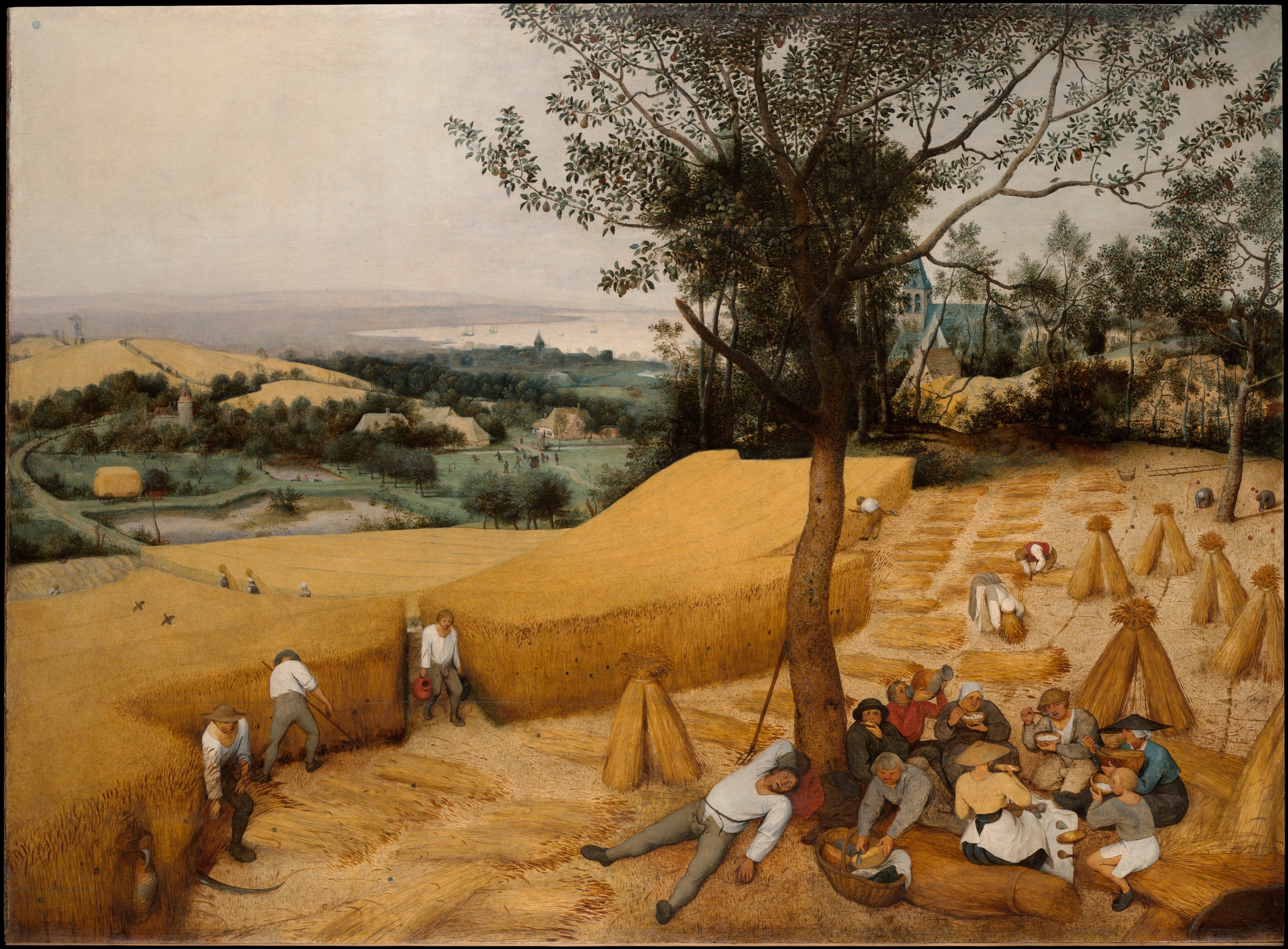
The Harvesters belonged to a six-part seasonal cycle commissioned by an Antwerp merchant for his country home's dining room. Workers cut grain, gather produce and rest. The image gives agricultural life dignity, but it also offers its wealthy viewer an idealised vision of abundance. It should not be read as an unmediated record of rural labour. [12]
Support, binder and paint layer
The support is oak, not canvas. Oil paint consists of pigment dispersed in a drying-oil medium. Its film develops through chemical reactions involving oxygen and cross-linking, rather than simply losing water. The slow evolution of that film helps explain why a painting's surface and mechanical behaviour continue to change over time. [12] [13]
Visual reading: building depth
The foreground tree anchors the scene while diagonals through the harvested field draw the eye outward. Figures become smaller toward the distance; the far landscape is less distinct. Compare the sharply legible meal beneath the tree with the hazier horizon. Depth is produced by several cooperating choices, not by perspective lines alone. [12]
The painting as an object
The museum distinguishes the original painted surface from the overall dimensions including later added strips. This is a reminder that a painting's present rectangular outline is not always identical to its first state. Catalogue measurements and technical notes can reveal changes that a small reproduction does not make obvious. [12]
A close-looking exercise
Divide the image into three zones: work, rest and distance. List one gesture, one colour relationship and one directional line in each. Then ask how the zones are connected. This exercise separates what can actually be observed from broader interpretations about season, prosperity or social order.
References and further reading
Image: The Metropolitan Museum of Art, New York · CC0. Museum Open Access photograph. Displayed at preview resolution; no content edits.

Modern art · Monuments & architecture
The Eiffel Tower
Gustave Eiffel's company; engineers Maurice Koechlin and Émile Nouguier; architect Stephen Sauvestre
1887–1889
Explore the relationship between industrial fabrication, wind, structural form and architectural identity.
Read the full studyClose this study
- Material
- Puddled iron, assembled with rivets
- Scale / format
- Designed as a 300-metre tower; later antennas are not part of that original design height
- Place
- Champ-de-Mars, Paris, France
History and authorship
Built for the 1889 Paris World's Fair, the tower emerged from collaborative engineering and architectural work. Koechlin and Nouguier developed the structural proposal within Eiffel's company; Sauvestre worked on its architectural appearance. Its exposed metalwork brought industrial construction into a highly visible public monument. [14]
Technical focus: iron is not steel
The primary metal is puddled iron. Puddling refined cast iron by reducing its carbon content, producing material that could be rolled into plates and simple sections. These components could then be assembled into larger members. The tower is therefore an example of built-up metal construction, not a single solid casting and not a modern welded steel frame. [15]
Rivets and fabrication
Components were prepared in workshops and assembled in sections. Heated rivets were formed into place and contracted as they cooled, producing tight connections. The official history records roughly 2.5 million rivets. This method depended on accurate drawings, repeatable fabrication and coordinated assembly as well as the properties of the metal itself. [14]
Form and wind
Four widely spaced lower supports converge upward through an open lattice. The curved profile responds to wind loading, while the open structure reduces the area exposed to it. The large arches around the first level also contribute to the monument's visual character. Engineering constraints and architectural choices must be studied together rather than assigning the whole appearance to one cause. [14]
How to look
Trace one leg from the ground to the top, then compare the scale of its members at different heights. Identify horizontal connections and diagonal bracing. In your own reading, distinguish a member that seems to carry or stabilise the structure from an element that mainly frames the visitor's view; verify uncertain cases against construction drawings.
References and further reading
Image: Benh LIEU SONG / Wikimedia Commons · CC BY-SA 3.0. Photograph displayed at reduced resolution without cropping or content edits. The photograph retains the licence linked above.
Modern art · Sculpture
The Thinker
Auguste Rodin; this bronze cast by Alexis Rudier
Modelled c. 1880; this cast c. 1910
Distinguish the sculptural model from a bronze cast and see how surface texture gives stillness energy.
Read the full studyClose this study
- Material
- Bronze
- Scale / format
- Height of this cast: 70.2 cm
- Place
- The Metropolitan Museum of Art, New York
A figure with more than one context
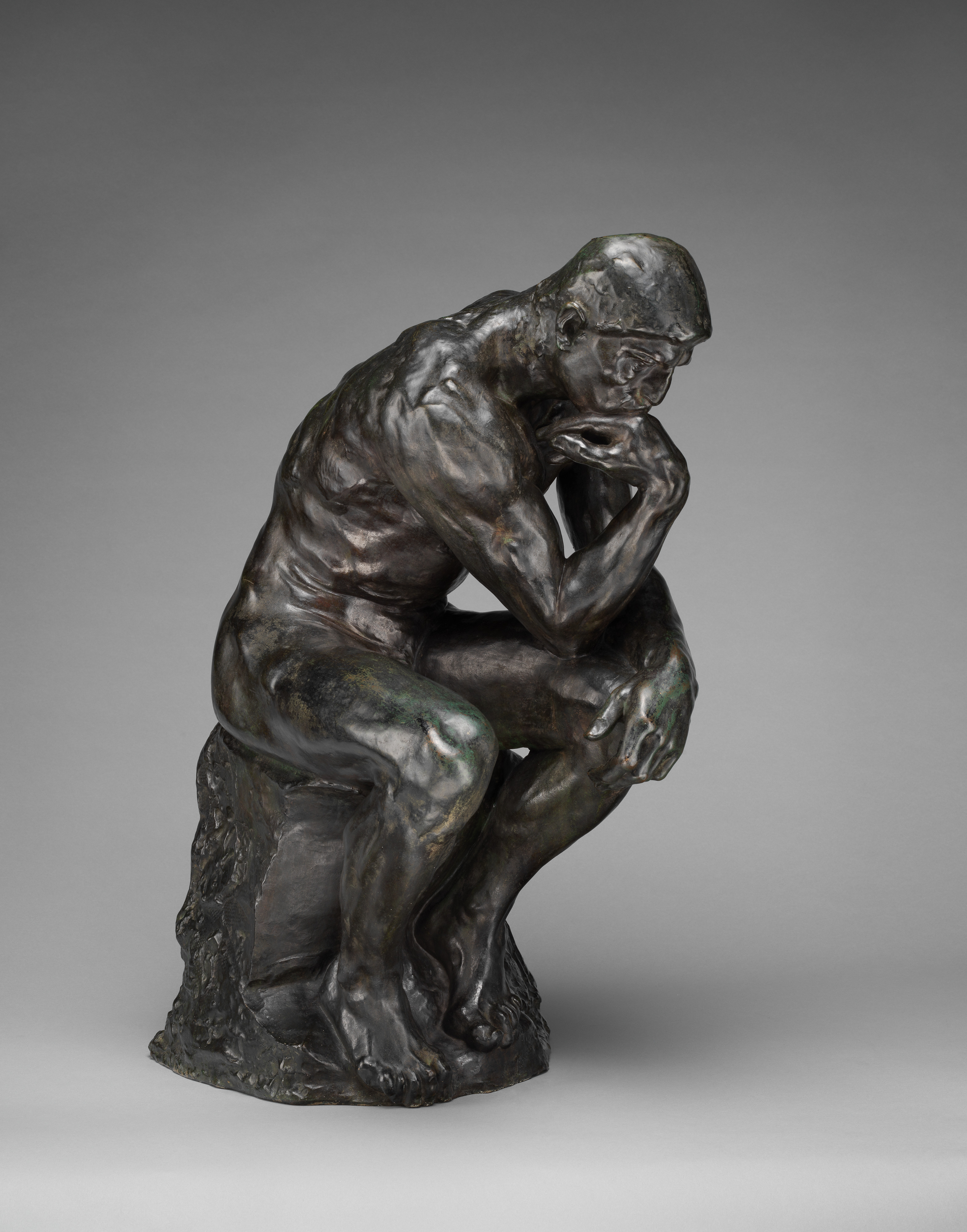
The Thinker was conceived for the upper part of The Gates of Hell, then became an independent sculpture. This example was commissioned from Rodin's studio by Thomas Fortune Ryan. Its recorded model and casting dates are different because creating a sculptural form and producing a particular bronze are separate events. [16]
Technical focus: from a model to hollow bronze
The Musée Rodin explains two major routes from a model to bronze: sand casting and lost-wax casting. Both use a mould and an internal core so that the resulting sculpture can be hollow. In sand casting, moulding sand is packed around a model, often handled in sections. In lost-wax casting, an expendable wax stage plays the corresponding part in forming the casting space. [17]
What is documented for this object
The Met identifies Alexis Rudier as the founder of this cast. Its basic record does not specify the entire foundry procedure. The general account of casting above should therefore not be treated as a technical report on this particular bronze. Multiple casts can differ in date, scale, surface treatment and history while deriving from a related model. [16] [17]
Visual reading: a body that thinks
Follow the bend from the head through the shoulder and down the back. The hand, forearm and legs form a compact network of supports. Irregularities in the surface break reflected light into small changes of tone. In this reading, thought is expressed through the body's tension and arrangement as much as through facial expression.
A useful comparison
Compare the polished transitions in Lombardo's Adam with the more visibly worked surface of The Thinker. Neither finish is a neutral wrapper. Each changes how light moves across the form and how the viewer imagines flesh, weight and effort. Use the high-resolution source to examine those differences.
References and further reading
Image: The Metropolitan Museum of Art, New York · CC0. Museum Open Access photograph. Displayed at preview resolution; no content edits.
Modern art · Painting
Wheat Field with Cypresses
Vincent van Gogh
1889
Examine impasto, directional brushwork and the distinction between the colour you see and the materials that produced it.
Read the full studyClose this study
- Material
- Oil on canvas
- Scale / format
- 73.2 × 93.4 cm
- Place
- Painted at Saint-Rémy; now The Metropolitan Museum of Art, New York
History and versions
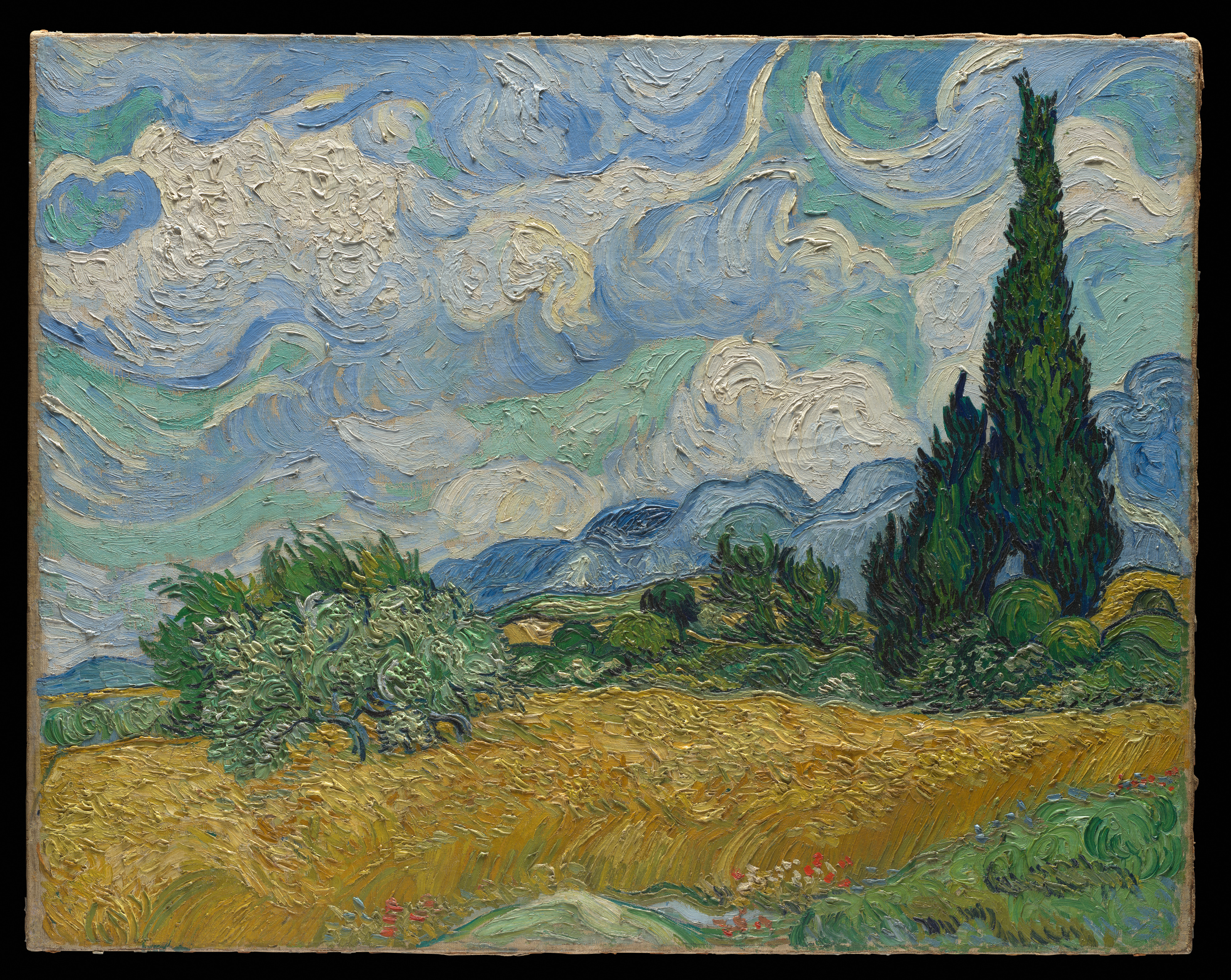
Van Gogh painted this landscape directly from nature during his time at Saint-Rémy in 1889. The Met's canvas is the summer study; he subsequently made two studio versions. Naming the museum and identifying the version matters because similarly titled paintings should not automatically share the same measurements, condition history or technical findings. [18]
Technical focus: impasto
Impasto is paint applied thickly enough for its physical relief to remain visible. Here, the raised strokes do more than describe a scene: their ridges also catch actual light. A photograph records some of that texture but cannot reproduce every effect of standing before a painting and changing your viewing angle. [18]
Oil paint is a changing material
A drying-oil film develops through oxidation and cross-linking. Thick and thin passages can behave differently as the film forms and ages. This is why the apparent freedom of a brushstroke should be studied alongside its material construction. A conservator needs more evidence than an image to assess stability or identify a particular pigment. [13]
Visual reading: different rhythms in one landscape
Compare the shorter strokes of the field with the circling movements in the sky and the upward thrust of the cypresses. Warm yellow and cooler blues establish a strong colour relationship, while the trees anchor the right side. This is a formal reading of visible relationships, not a chemical identification of the paint or a diagnosis of the artist.
How to look closely
Choose a small passage at the edge of a cloud and another among the wheat. Identify the direction, length and thickness of several strokes. Then step back to see how they merge into larger forms. Move between the painted mark as a physical trace and the landscape it helps construct.
References and further reading
Image: The Metropolitan Museum of Art, New York · CC0. Museum Open Access photograph. Displayed at preview resolution; no content edits.
No studies match these filters.
TOOLS FOR LOOKING
A short technical glossary
Support, ground and paint layer
The support carries a painting; a ground prepares its surface; the paint layer contains colour and a binding medium. A support may be a wall, wooden panel or canvas.
Buon fresco / secco
Buon fresco applies colour to fresh lime plaster; secco painting works on a dry surface. The distinction concerns how colour is fixed, not simply whether a painting is on a wall. [7]
Binder
The material that holds pigment particles together and helps attach them to a support. A drying oil is one kind of binder; it forms a film through chemical reactions. [13]
Impasto
A sufficiently thick application of paint to leave raised strokes or other surface relief. Its physical texture interacts with the light falling on the painting.
Contrapposto
A standing pose organised around a weight-bearing leg and a relaxed leg, with corresponding adjustments through the hips and torso.
Polychromy
The use of multiple colours on a work, including sculpture. Present-day bare stone does not by itself prove that an object was originally unpainted. [4]
Raised relief / sunk relief
In raised relief the design projects from a cut-back background. In sunk relief the design is cut into the surface. The two arrangements produce different shadows.
Model / cast
A model establishes a sculptural form. A cast is an object produced through a moulding and casting process; its making date may differ from that of the model.
Double shell
Two curved layers separated by a space. In a dome, their relationship must be understood together with connections, supporting members and the structure below.
Compression and thrust
Compression pushes material together. In arches and vaults, loads may also create outward forces on supports; geometry and restraint help keep those forces within the structure.
Rivet
A permanent metal fastener with formed heads. The Eiffel Tower's hot-driven rivets tightened as they cooled, connecting separate iron components.
Stiffness and reversibility
Stiffness describes resistance to deformation, not the same thing as strength. Reversibility concerns whether a conservation intervention can later be removed or revised with limited harm.