Stadia Home / Our Planet / One planet, many worlds
STADIA SCIENCE & HISTORY
Ancient
Civilizations.
Peoples, places and connections.
Explore cities and kingdoms across Mesopotamia, Anatolia, the Nile Valley and the Mediterranean. Read their histories through landscapes, work, beliefs, conflict and exchange.
A connected reading journey · Comparative chronology · Evidence lab
These societies overlapped and influenced one another. They were never sealed worlds or steps on a single ladder of progress. The word civilization is used here as a historical shorthand, not a ranking of human worth. This is a regional introduction, not a complete history of all ancient societies.
READ ACROSS TIME
Who lived at the same time?
BCE means Before Common Era; CE means Common Era. In this convention, 1 BCE is followed by 1 CE, with no year zero. Earlier BCE dates have larger numbers. Most boundaries below are approximate and depend on scholarly conventions.
Bars share a single horizontal scale from 3500 BCE to 500 CE. They show selected political or cultural periods, not the entire lives of peoples, languages or traditions.
All selected periods are shown.
| Society or political phase | Dates | 3500 BCE → 500 CE |
|---|---|---|
| Sumer: cities and Sumerian dynasties | 3500 BCE – 2000 BCE | |
| Akkadian Empire | 2350 BCE – 2150 BCE | |
| Old Babylonian period | 2000 BCE – 1595 BCE | |
| Neo-Assyrian Empire | 911 BCE – 609 BCE | |
| Neo-Babylonian Empire | 626 BCE – 539 BCE | |
| Hittite kingdom and empire | 1650 BCE – 1200 BCE | |
| Egypt: dynastic kingdoms to Roman conquest | 3100 BCE – 30 BCE | |
| Kerma kingdom | 2500 BCE – 1450 BCE | |
| Kush: Napatan and Meroitic periods | 800 BCE – 350 CE | |
| Phoenician cities: selected flourishing period | 1200 BCE – 300 BCE | |
| Achaemenid Empire | 550 BCE – 330 BCE | |
| Minoan palatial Crete | 1900 BCE – 1450 BCE | |
| Mycenaean palatial societies | 1600 BCE – 1200 BCE | |
| Archaic and Classical Greek worlds | 800 BCE – 323 BCE | |
| Hellenistic kingdoms | 323 BCE – 30 BCE | |
| Etruscan cities: selected period | 900 BCE – 90 BCE | |
| Roman Republic: conventional dates | 509 BCE – 27 BCE | |
| Roman Empire: Augustus to western imperial end | 27 BCE – 476 CE |
Sources for dates are listed with each society below. Chronological systems differ, especially for early Mesopotamia. The Roman row ends at a western political marker; the Eastern Roman Empire continued. Without JavaScript, the complete comparison remains readable.
Why does a bar stop when a culture continues?
A kingdom can lose political independence while its language, religious practices and local communities persist. These bars are tools for comparison; conquest is not the disappearance of a population.
PEOPLES & PLACES
Sumer: cities, writing and water
Fourth and third millennia BCE; Sumerian traditions continued later.Locate it: Southern Mesopotamia, mainly in present-day southern Iraq, between and around the Tigris and Euphrates.
Cities such as Uruk, Ur and Lagash developed in a landscape of channels, fields and wetlands. Sumer was not a single continuously unified state. Its cities competed, formed alliances and sometimes came under rulers who controlled wider territories.
Water and work
Canals supported farming but required maintenance and negotiation over water and labour. Grain production sustained urban populations; herding, fishing, craft production and trade also mattered. The landscape created opportunities and constraints without determining a single political outcome.
Institutions and inequality
Temples and palaces organised resources and employed workers, alongside households and other economic arrangements. Rulers linked authority to divine favour. Administrative records reveal labour and allocations, but seldom allow workers to speak in their own words.
Writing and knowledge
Late fourth-millennium records at Uruk are among the earliest evidence for writing. Over time, cuneiform served accounting, letters, scholarship and literature. It was a writing system used for several languages, not a language itself.
Exchange and survival
Imported stone, timber and metals connected southern cities with distant regions. Seals, vessels and texts help reconstruct those connections. Sumerian survived as a learned and religious language after it ceased to be widely spoken.
Read the evidence
A tablet recording grain allocations is strong evidence for an administrative transaction. It does not by itself establish the diet, legal status or freedom of every recipient. Compare its wording, archaeological context and other records.
PEOPLES & PLACES
Akkad, Babylon and Assyria: changing forms of power
Third millennium to sixth century BCE: several different states and periods.Locate it: Southern and northern Mesopotamia, with empires at times extending far beyond it.
Political centres moved, while scribal learning and local traditions crossed dynastic boundaries. Akkad, Babylon and Assyria should not be treated as three names for the same empire.
Akkadian rule
In the later third millennium BCE, Sargon and his successors brought extensive territories under Akkadian kingship. Royal monuments projected conquest and authority. Governing distant cities required officials and negotiation as well as military force; imperial control varied over time.
Babylon and law
Hammurabi ruled Babylon in the eighteenth century BCE. His famous law collection reveals ideas about justice and unequal social status. It was neither the earliest known law collection nor a complete transcript of everyday court practice. Babylon later became a major scholarly and religious centre.
Assyrian empire
The Neo-Assyrian state expanded through warfare, provincial administration, tribute and forced population transfers. Palace reliefs promoted the king’s power; archives illuminate administration. Reading these sources together exposes both imperial organisation and the violence experienced by conquered communities.
Continuity after conquest
The Neo-Babylonian kingdom followed Assyrian decline. Persia conquered Babylon in 539 BCE, but the city and its institutions continued. A change of ruler did not erase every local practice. Temples, scholarly traditions and urban communities could outlast dynasties.
Read the evidence
Royal inscriptions explain how a ruler wished to be remembered. Their claims need comparison with other texts, settlement evidence and material remains. A victory scene is not an impartial report of a campaign.
PEOPLES & PLACES
The Hittites: an Anatolian power
Approximately 1650–1200 BCE for the kingdom and empire.Locate it: Central Anatolia, in present-day Türkiye, with Hattusha as a principal capital and influence extending into Syria.
Hittite power linked a highland heartland with neighbouring kingdoms and dependent rulers. Its history belongs to a multilingual eastern Mediterranean world of alliances, rivalry and exchange.
Kings and agreements
Rulers combined military campaigns with treaties, dynastic marriages and arrangements with subordinate kings. Archives show obligations, loyalties and disputes. A treaty records an intended relationship, not proof that everyone always obeyed it.
Language and religion
Hittite is an Indo-European language recorded in cuneiform. Archives also preserve other languages and traditions. Royal religion drew on diverse local cults; the surviving texts reflect the needs of the court and temples more than the full lives of villagers.
Egypt and Syria
Hittite and Egyptian interests collided in Syria, including at Kadesh in the thirteenth century BCE. Conflict was followed by diplomacy. Comparing records from rival courts shows how the same political world could be described differently.
The end of imperial rule
Central Hittite power collapsed around 1200 BCE during wider regional disruption. Causes and local sequences remain debated. Later kingdoms in northern Syria and southeastern Anatolia preserved and reworked elements of these traditions.
Read the evidence
Clay treaties and ritual texts reveal institutions exceptionally well. Farming households are less visible in court archives, so archaeologists also examine buildings, tools, plant remains and animal bones. Political collapse should not be equated with the disappearance of all inhabitants.
PEOPLES & PLACES
Egypt: the Nile, kingship and everyday life
Dynastic history from about 3100 BCE; Roman conquest in 30 BCE was a political transition.Locate it: The Nile Valley and Delta, with changing connections to deserts, the Levant and regions farther south.
Egyptian history spans thousands of years. The labels Old, Middle and New Kingdom identify major phases of political organisation, separated by periods of regional rule and transformation. Dates vary slightly among reference chronologies.
The Old Kingdom
In the third millennium BCE, royal building programmes, including pyramids, mobilised extensive resources. Monumental tombs expressed kingship and religious ideas. Their construction also depended on quarrying, transport, provisioning, skilled work and administration.
Middle and New Kingdoms
Reunification around the start of the Middle Kingdom accompanied renewed state organisation and important literary traditions. During the New Kingdom, roughly 1550–1070 BCE, Egyptian power extended beyond the Nile heartland and interacted with neighbouring empires.
Life beyond the monuments
Agriculture, craft production and household work supported society. Evidence from the workers’ village at Deir el-Medina gives unusually detailed glimpses of work and community life. It is a valuable case study, not a representative sample of every Egyptian settlement.
Belief, power and change
Temples and funerary practices linked humans, gods and the dead. Egyptian religion changed across places and centuries. Later Kushite, Persian, Macedonian and Roman rule introduced new political relationships while many local practices persisted.
Read the evidence
Surviving monuments favour royal and wealthy patrons. Burial goods can express ideals and status rather than reproduce ordinary life. To understand broader society, compare texts and tombs with houses, food remains, workplaces and settlement patterns.
PEOPLES & PLACES
Ancient Sudan: Kerma, Kush, Napata and Meroe
Kerma approximately 2500–1450 BCE; later Kushite power from the first millennium BCE into the fourth century CE.Locate it: The Middle Nile in present-day Sudan. Nubia is a historical region extending across parts of modern Sudan and southern Egypt.
The societies south of Egypt had their own political histories, artistic traditions and networks. Their story cannot be reduced to Egyptian expansion. Modern national borders are guides to location, not ancient boundaries.
Kerma
A powerful kingdom developed around Kerma, with monumental mudbrick structures, specialised crafts and extensive cemeteries. Archaeology reveals an organised urban centre and regional connections. Egyptian conquest around the fifteenth century BCE changed the political balance.
Napata and Kushite kings
In the first millennium BCE, Kushite rulers based in the Napatan region expanded northward and ruled Egypt as its Twenty-fifth Dynasty. This was an African kingdom exercising power in both directions along the Nile, not merely receiving influence from the north.
Meroe and regional networks
Meroe became a major royal and economic centre. Pyramids, temples and other remains document a distinctive society connected with wider African and Mediterranean networks. Agriculture, craft production and exchanges sustained life beyond the royal monuments.
Language and historical visibility
Meroitic signs can be read phonetically, but understanding of the language remains incomplete. This limits what inscriptions can tell us. Archaeology is therefore vital, and Egyptian or Greek descriptions must not substitute automatically for Kushite perspectives.
Read the evidence
Compare a royal monument with a settlement or cemetery. Each offers a different selection of evidence. The end of Meroitic royal power did not mark the end of Sudanese history or of the communities living along the Nile.
PEOPLES & PLACES
Phoenicians and Persia: networks and empires
First millennium BCE; Achaemenid Empire approximately 550–330 BCE.Locate it: Phoenician cities on the Levantine coast; the Persian imperial heartland in Iran, connected to territories across western Asia and beyond.
Two contrasting forms of connection help explain the ancient world: maritime networks centred on cities, and large territorial empires. Neither was socially uniform or free from conflict.
Phoenician cities
Tyre, Sidon and Byblos belonged to a coastal world of independent cities rather than a single permanent Phoenician nation-state. Seafaring merchants and settlers connected ports across the Mediterranean. Carthage developed into a major power in its own right.
Writing across the sea
Phoenician alphabetic writing influenced other scripts, including Greek. Adaptation was creative: writing systems changed to serve different languages. Shared goods and styles also show contact, but an imported pot alone cannot identify the language of its owner.
Achaemenid administration
Cyrus and later Persian rulers built a vast empire. Provincial government, tribute and communications linked diverse territories. Local elites and traditions continued within imperial structures, while rebellion and coercion remained part of imperial rule.
Conquest and new configurations
Alexander’s campaigns brought down the Achaemenid dynasty in the fourth century BCE. Successor kingdoms reused and adapted existing institutions. Imperial transitions combined continuity with profound changes in power and access to resources.
Read the evidence
Compare an imperial inscription with documents from a provincial community. Do they describe the same obligations in the same way? A ruler’s claim to protect order must be evaluated alongside evidence of taxation, warfare and local responses.
PEOPLES & PLACES
Greek worlds: from palaces to cities and kingdoms
Bronze Age Aegean societies; Archaic, Classical and Hellenistic periods.Locate it: Crete, mainland Greece and Aegean islands, with communities and kingdoms across the Mediterranean and western Asia.
Ancient Greece was not one continuously united country. Language, sanctuaries and traditions connected communities that also competed and fought. Earlier Minoan Crete should not simply be assigned the identity of later Greek-speaking societies.
Minoan and Mycenaean worlds
Cretan palatial centres organised resources and craft production. Mycenaean centres on the mainland participated in Aegean networks; their Linear B records encode an early form of Greek. Linear A remains undeciphered. Disruption around 1200 BCE transformed the palatial world.
The polis and its exclusions
In later centuries, city-states developed different political systems. Athens’ democracy gave political power to male citizens but excluded women, enslaved people and resident foreigners from that participation. Sparta organised citizenship and power differently; neither city represents every Greek community.
Culture, work and conflict
Sanctuaries, drama, philosophy and visual arts were embedded in civic and religious life. Farming, maritime exchange, household labour and slavery sustained these worlds. Colonisation brought settlers into relations with existing populations, involving exchange, competition and displacement.
Hellenistic connections
After Alexander’s death in 323 BCE, successor kingdoms linked Greek-speaking elites with diverse populations. New cities and royal centres encouraged artistic and scholarly activity. Cultural exchange was extensive, but it occurred within unequal political relationships.
Read the evidence
Homeric poetry is not a contemporary administrative record of Bronze Age palaces. Treat genre and date as part of the evidence. Likewise, a philosophical text written by an elite man cannot speak for every person in a city.
PEOPLES & PLACES
The Etruscans: cities at the heart of ancient Italy
Especially the first millennium BCE; progressive incorporation into Roman rule.Locate it: Etruria in central Italy, especially present-day Tuscany and parts of Lazio and Umbria, with wider connections and settlements.
Etruscan cities formed a distinctive cultural world without a single enduring centralised state. Their histories intersected with other Italian peoples, Greek communities and Phoenician and Carthaginian networks.
Cities and resources
Agriculture and mineral resources supported communities, trade and skilled production. Metalwork, terracotta sculpture, jewellery and pottery reveal technological expertise and varied contacts. Imported objects were selected and reinterpreted within local practices.
Belief and public life
Temples, votive offerings and funerary settings provide evidence for religious practice. Later Roman writers associated Etruscans with expertise in divination. Such accounts are useful but reflect Roman interests as well as older traditions.
Families and representation
Tomb paintings and sculpted couples make some elite women especially visible. These images challenge assumptions drawn from other ancient societies, but cannot establish the rights or daily experience of every woman, labourer or enslaved person.
Language and Rome
Etruscan inscriptions can often be read, though vocabulary and interpretation remain limited by the surviving corpus. Roman expansion progressively ended cities’ independence. Etruscan people and practices continued within a changing Italian world.
Read the evidence
Most surviving inscriptions are short, and tombs are disproportionately prominent in the archaeological record. Compare funerary display with settlements and workshops. Neither Roman stereotypes nor lavish burials provide a complete social portrait.
Explore the sources: [19]
PEOPLES & PLACES
Rome: expansion, citizenship and transformation
Traditional Republic: 509–27 BCE; imperial rule from Augustus; western imperial marker: 476 CE.Locate it: From a city on the Tiber to a Mediterranean empire encompassing territories in Europe, Africa and Asia.
Stories about Rome’s earliest kings combine memory, tradition and later political interpretation. The familiar dates organise a complicated history; they should not be mistaken for equally secure archaeological boundaries.
Republic and conquest
Republican institutions included magistrates, assemblies and the Senate, with unequal access to influence. Expansion brought land, wealth, captives and new obligations. Warfare and competition among leaders contributed to the crises that ended republican government.
Emperors and provinces
Augustus consolidated a new concentration of power while retaining republican forms. Provincial cities, armies, taxation and transport linked the empire. Roads and ports carried soldiers and goods, but integration also depended on local institutions and negotiation.
Whose Roman life?
Citizenship, wealth, gender and legal status shaped opportunity. Enslaved people worked in households, fields, workshops and other settings. Elite villas and monumental centres survive prominently, but inscriptions, modest dwellings and everyday objects widen the picture.
Late antiquity
Religious change, political reorganisation, migration and warfare transformed the empire. The removal of a western emperor in 476 CE is a conventional landmark, not the end of Roman life. Eastern imperial government continued, and many institutions and practices changed gradually.
Read the evidence
A legal text tells us what an authority prescribed; a letter or archaeological assemblage may show different practice. Avoid treating the empire as one uniform culture or assuming that official identity erased local languages and traditions.
COMPARE THE WORLDS
Connections across regions
Eastern Mediterranean, around 1250 BCE
Hittite Anatolia, New Kingdom Egypt and Mycenaean centres shared a world of maritime routes and overland diplomacy. Syria and the Levant were important contact zones. The relevant borders and alliances changed frequently.
Mediterranean and Nile, around 200 BCE
Rome was expanding, Hellenistic kingdoms held power in several regions, and Kush remained an independent Nile kingdom. Cultural interaction crossed political boundaries; conquest did not instantly replace local identities.
These are regional orientation summaries, not reconstructions of fixed borders. Use the location notes and dated institutional sources when consulting maps.
HISTORIAN’S WORKSHOP
What can a source really tell us?
Select a type of evidence, then consider its strengths and blind spots. These are teaching examples, not quotations from an individual artefact.
All three examples are available below.
A royal victory inscription
Useful for: official claims, royal titles and the language of legitimacy.
Limits: victories can be exaggerated and defeats omitted. Compare rival accounts, destruction layers and settlement histories.
A household or ration account
Useful for: recorded quantities, people, transactions and administrative categories.
Limits: the record may cover only one institution or moment. It does not automatically reveal the whole economy or everyone’s lived experience.
A richly furnished burial
Useful for: funerary choices, materials, craftsmanship and social display.
Limits: a burial is a selective ritual arrangement. Wealthy graves do not represent an entire population, and objects can have several meanings.
Questions for discussion
Why were the Egyptians and Hittites able to negotiate?
They were contemporary powers with intersecting interests. A treaty belongs to a relationship that could involve both warfare and diplomacy.
Was ancient Sudan simply part of Egypt?
No. Kerma and later Kush had independent histories and institutions. At different times, domination ran in different directions, including Kushite rule over Egypt.
Does imported pottery prove migration?
No. It might result from trade, gift exchange, travel or movement of people. Distribution, manufacture and archaeological context help distinguish possibilities.
Did democracy mean equal rights for everyone in Athens?
No. Political participation was restricted. Studying exclusions is essential to understanding both the institution and the labour supporting it.
Did the Etruscans disappear when Rome expanded?
Loss of independent government did not mean the immediate disappearance of people, language or cultural practices.
What links these histories to Our Planet?
Food, water, energy, materials and landscapes supported every society. Institutions and choices shaped how people used them; environmental conditions alone do not explain a civilisation’s history.
Notes are not saved or sent. Copy them before leaving this page.
Stadia Vitae · Ancient Civilizations · stadiaorg.com/ancient-civilizations/
REFERENCE SHELF
Explore the sources
Museum essays, archaeological research and heritage institutions offer starting points for deeper study. Dates and interpretations can vary between sources; older essays should be read alongside newer research. Evidence notes on this page are original learning prompts.
- The Met: Art of the First Cities
- The Met: The Akkadian Period
- The Met: Babylon
- The Met: Assyria to Iberia
- The Met: The Hittites
- British Museum: Treaty of Muwattalli II and the king of Aleppo
- Egyptian Ministry of Tourism and Antiquities: Old Kingdom
- Egyptian Ministry of Tourism and Antiquities: Middle Kingdom
- The Met: Egypt in the New Kingdom
- British Museum: Sudan, Egypt and Nubia
- Swiss archaeological mission: The city of Kerma
- UNESCO: Archaeological Sites of the Island of Meroe
- The Met: The Phoenicians
- The Met: The Achaemenid Persian Empire
- The Met: Minoan Crete
- The Met: Mycenaean Civilization
- The Met: The Art of Classical Greece
- The Met: Art of the Hellenistic Age
- The Met: Etruscan Art
- The Met: The Roman Republic
- The Met: The Roman Empire
Prepared October 2026. Selected chronologies are approximate. No modern territorial claim is implied by ancient geographical names.
Beyond the Mediterranean: the wider human story
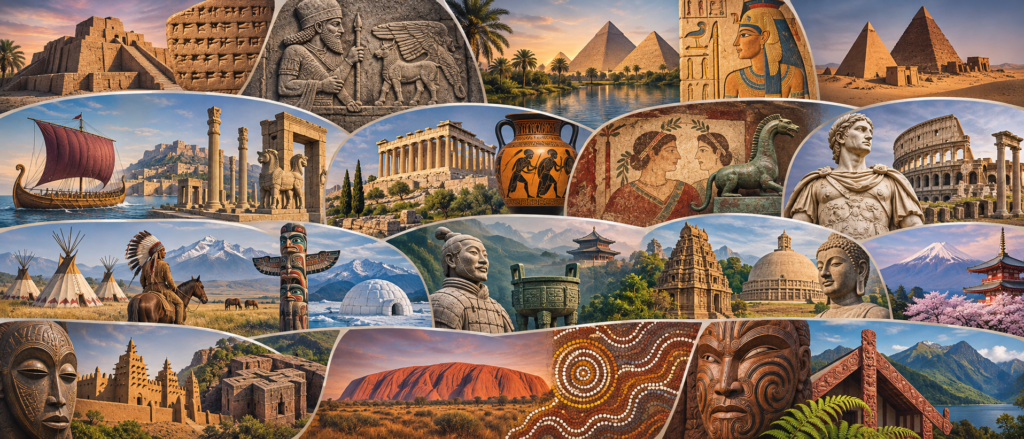
Explore the remarkable diversity of ancient societies and living cultural traditions across the Americas, Asia, Africa and Oceania. These histories developed on different timelines, in different environments, and cannot be ranked along a single ladder of progress.
The Americas
Indigenous histories extend far beyond a single empire or a single continent-wide narrative.

Cahokia and the ancestral Pueblo world
Before European colonisation, North America was home to diverse Indigenous nations and sophisticated regional centres. Cahokia, near today’s St Louis, was the largest pre-Columbian settlement north of Mexico; its monumental earthworks expressed political, religious and agricultural organisation. In the American Southwest, ancestral Pueblo communities developed remarkable architecture and long-distance exchange networks, including at Chaco Canyon. Their histories connect with living Indigenous communities today.
UNESCO · Cahokia Mounds ↗
Maya cities: Tikal
The Maya developed cities, writing systems, mathematics, astronomy and distinctive architecture across parts of present-day Guatemala, Mexico, Belize and neighbouring regions. Tikal preserves major temples, palaces and plazas within a tropical forest. Maya languages, knowledge and cultural traditions continue today; the archaeological city is not the end of the Maya story.
UNESCO · Tikal National Park ↗
The Andes and the Inca
Andean societies developed complex agricultural terraces, roads, administrative systems and stone-building traditions across many centuries. The Inca integrated vast highland and coastal territories in the 15th and early 16th centuries. Machu Picchu illustrates exceptional Inca engineering and landscape design. The wider region also preserves earlier histories, including those of the Moche, Nazca, Tiwanaku and Wari.
UNESCO · Machu Picchu ↗Asia & Anatolia
Cities, dynasties and cultures across an immense and varied region.

China: dynasties, writing and imperial power
Early Chinese history includes the bronze-working Shang, the Zhou, the unification under Qin and the long-lasting cultural and administrative influence of Han. Oracle-bone inscriptions document early Chinese writing. The terracotta army, buried with the first Qin emperor in the 3rd century BCE, reveals the ambition and organisation of an imperial court. Neighbouring Korean and Japanese histories followed their own distinct paths, including Korea’s early kingdoms and Japan’s Jōmon traditions.
UNESCO · Mausoleum of the First Qin Emperor ↗
The Indus civilisation
Long before many later Indian kingdoms, the Indus civilisation developed large settlements in today’s Pakistan and north-western India. Mohenjo-daro is renowned for planned streets, wells, bathing facilities and an elaborate drainage system. Its undeciphered script remains a major historical puzzle. This chapter opens the way to the later diverse histories of South Asia rather than reducing them to one single civilisation.
UNESCO · Moenjodaro ↗
Southeast Asia: the Khmer world
The Khmer Empire developed large urban and sacred landscapes around Angkor, in present-day Cambodia. Temples such as Angkor Wat and the Bayon are only one part of the story: canals, reservoirs and engineered water systems sustained a complex society. Their buildings and inscriptions illuminate links across South and Southeast Asia, while Cambodian communities carry forward living cultural traditions.
UNESCO · Angkor ↗
Anatolia: a bridge between regions
Ancient Anatolia—roughly modern Türkiye—connected the Aegean, the Black Sea, Mesopotamia and the Levant. The Hittite capital Hattusa shows major fortifications, temples and royal spaces. After and alongside Hittite rule, Phrygian, Lydian and other Anatolian cultures contributed their own languages, crafts and political traditions. This is a complementary perspective on the Hittites already covered earlier on the page.
UNESCO · Hattusha ↗Africa
Connected African centres of power, creativity and exchange beyond Egypt and Nubia.

Africa beyond the Nile: Aksum and other centres
The African past extends far beyond the Nile Valley. The Kingdom of Aksum, centred in present-day Ethiopia and Eritrea, was linked by trade to the Red Sea, Arabia and the Mediterranean. Its carved stone stelae, inscriptions and monuments testify to a powerful state. Elsewhere, Carthage was a major Mediterranean power, while the Nok tradition of West Africa produced distinctive terracotta sculpture. Africa’s histories are regional, diverse and interconnected.
UNESCO · Aksum ↗Australia & Pacific
Long human histories and living First Peoples’ traditions across the Pacific.

Australia: the living heritage of First Peoples
Aboriginal and Torres Strait Islander peoples encompass many distinct living cultures, languages and knowledge systems. Archaeological evidence points to Aboriginal presence in Australia for at least 65,000 years. In Gunditjmara Country, the Budj Bim Cultural Landscape preserves an intricate aquaculture system for managing and harvesting eels, developed over at least 6,600 years. This history must not be judged solely by the presence or absence of stone cities.
UNESCO · Budj Bim ↗
Aotearoa New Zealand: Māori and Pacific voyaging
The ancestors of Māori reached Aotearoa New Zealand by skilled long-distance ocean voyaging from East Polynesia, with permanent settlement generally dated to about 1250–1300 CE. Communities developed distinctive architecture, agriculture, carving, political relationships and seafaring knowledge. This chapter belongs to a wider human-history perspective: its dates are much later than Bronze Age civilisations, and Māori culture remains vibrant today. The photograph shows a modern waka, illustrating a living tradition rather than an excavated ancient vessel.
Te Ara · Māori arrival and settlement ↗Native Nations of North America: enduring cultures and histories
From the Great Plains to the Great Lakes, Canada, Alaska and the Arctic, Indigenous nations developed distinct languages, forms of government, ecological knowledge and artistic traditions. These are living peoples—their histories did not end with European colonisation.
Great Plains: peoples, horses and the buffalo
The Plains were never home to just one culture: nations formed alliances, changed their ways of life, defended their homelands and continue to govern and sustain communities today.

Cheyenne — Tsistsistas / Suhtai
Cheyenne communities have histories that reach from the Great Lakes and upper Mississippi country to the Great Plains. Farming, trade, hunting, horses and political alliances shaped different periods of their history. The Northern and Southern Cheyenne remain distinct living communities with active cultural and language programmes.
Cheyenne and Arapaho Tribes — History & culture
Comanche — Nʉmʉnʉʉ
The Comanche emerged as a major equestrian nation of the southern Plains during the eighteenth and nineteenth centuries. Horse breeding, trade and mobility transformed life across a vast region often called Comancheria. Their history also includes diplomacy, conflict, forced displacement and the continued vitality of the Comanche Nation today.
Comanche Nation — History
Oceti Sakowin — Lakota, Dakota and Nakota
Often grouped under the historical name “Sioux”, the Oceti Sakowin, or Seven Council Fires, include related but distinct Dakota, Lakota and Nakota peoples and communities. Their histories encompass farming, bison hunting, political alliances, treaties and resistance to dispossession. Nations across the US and Canada continue their cultural, linguistic and political lives.
Smithsonian NMAI — Oceti Sakowin
Niitsitapi — Blackfoot Confederacy
The Blackfoot Confederacy includes closely related Plains nations with deep ties across the modern Canada–US border. Bison, land, kinship, seasonal travel and enduring spiritual traditions have shaped their lives. The historical photograph illustrates a particular moment, not the full diversity of present-day Blackfoot communities.
Smithsonian NMAI — Northern PlainsCanada: First Nations and the Great Lakes
Across the boreal forests, Great Lakes, St Lawrence region and Pacific coast, Indigenous nations developed varied languages, governments, art forms and diplomatic traditions. The modern border cannot contain their histories.

Cree — Nêhiyawak and related communities
Cree-speaking peoples encompass many distinct communities across a large part of Canada, from eastern woodlands to western Plains. Rivers and lakes supported travel, trade and seasonal life; histories differ across the region. Cree languages and contemporary nations remain central to Canadian Indigenous life.
Canadian Museum of History — Canadian History Hall
Anishinaabe — Ojibwe, Odawa and others
The Anishinaabe family of peoples spans the Great Lakes and adjoining regions. Fishing, agriculture, maple harvesting, the birchbark canoe, cultural teachings and long-distance networks all feature in different communities’ histories. Treaties, language revitalisation and cultural sovereignty remain important today.
Parks Canada — Indigenous-led experiences
Haudenosaunee — the Six Nations
The Haudenosaunee Confederacy is a political and diplomatic union associated with the Mohawk, Oneida, Onondaga, Cayuga, Seneca and Tuscarora. Its traditions of council, consensus and the Great Law of Peace have deep histories. Wampum belts record relationships and agreements; they are not simply decorative objects.
Haudenosaunee Confederacy — League of Nations
Haida — Xaayda / X̱aayda
Haida life is rooted in the islands of Haida Gwaii and surrounding waters. Cedar canoes, houses and monumental carvings express sophisticated knowledge, social relationships and artistry. Modern Haida communities continue to shape the care and interpretation of their own cultural heritage.
Parks Canada — Haida Gwaii WatchmenAlaska and the Arctic: distinct living cultures
Alaska Native peoples are not a single “tribe”. Their diverse languages, regional knowledge and artistic traditions connect ocean, tundra, interior forests and the North Pacific.

Iñupiat — Arctic Alaska
Iñupiat communities have longstanding relationships with Arctic lands and seas. Knowledge of sea ice, marine mammals, seasonal travel and community cooperation has supported life in northern Alaska for generations. The umiaq, a skin-covered boat, illustrates specialised engineering rooted in local environments.
Alaska Native Heritage Center — Museum & research
Yup’ik and Cup’ik
Yup’ik and Cup’ik communities maintain distinctive languages, stories, arts and relationships with the riverine and coastal environment. Carved masks are among the best-known forms of historic Yup’ik visual expression, although particular objects require careful cultural context. Living traditions extend far beyond museum collections.
Alaska Native Heritage Center — Village sites
Tlingit — Łingít
Tlingit society is shaped by clans, kinship, oral histories, maritime life, carving and complex relationships with neighbouring Northwest Coast peoples. Clan houses and poles can carry historical meanings. The photographed clan house is a heritage interpretation, not an untouched ancient settlement.
Alaska Native Heritage Center — Culture groups
Unangax̂ — Aleutian Islands
Unangax̂ peoples have navigated the northern Pacific for centuries through advanced marine knowledge, fishing, hunting and boatbuilding. Their history includes major disruptions under Russian colonial expansion and later wartime relocations. A historic mask catalogued as Western Aleut is shown here with its uncertain precise provenance explicitly acknowledged.
Alaska Native Heritage Center — Museum & research