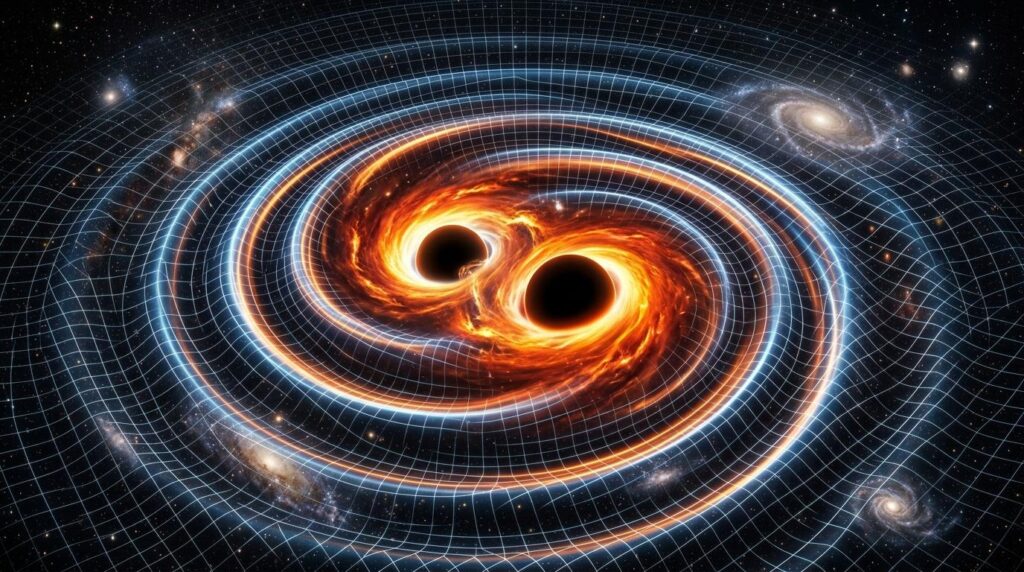
Can we travel through time?
What is time, and can we change its direction?
Stadia Vitae — Science, Mathematics & the Universe
The central question: Is time an invisible river carrying us toward the future, or a dimension of the universe that we might one day learn to navigate?
1. The Mystery of Time
We measure time with clocks, observe it through change and experience it through memory. Yet measuring time is not the same as explaining what time actually is.
Isaac Newton described time as absolute: a universal background that passes uniformly, independently of events.
Albert Einstein transformed this picture. In relativity, space and time form spacetime. Time measurements depend on motion and gravity, and distant observers do not necessarily agree on which events occur simultaneously.
Time is therefore not a universal clock shared by the entire universe.
2. Can Time Really Slow Down?
Yes. Time dilation is an experimentally established phenomenon.
An observer moving at high speed relative to another may accumulate less elapsed time between suitable events. This is not merely an illusion or a defect in the clock. All physical processes, including biological aging, follow the elapsed time along their trajectory.
The effect becomes significant at velocities approaching the speed of light.
The fundamental relationship is:
Here, τ is the proper time measured by the moving clock, t is the corresponding time interval in the chosen inertial reference frame, v is the relative velocity and c is the speed of light.
For example, a spacecraft travelling at 80% of light speed experiences approximately six years of elapsed time during an interval of ten years in Earth’s reference frame, ignoring acceleration and gravitational effects.
At 99% of light speed, the difference is much greater.
3. The Twin Paradox
Imagine two twins.
One remains on Earth, while the other leaves in a high-speed spacecraft and eventually returns.
When they meet again, the travelling twin can be younger.
This is not a contradiction. Their journeys through spacetime are different. The journey involves a change of reference frame, and their accumulated proper times need not be equal.
Two people can leave an event together, reunite later and have experienced different amounts of time.
4. Gravity Changes Time
According to general relativity, gravitational fields also affect the passage of time.
A clock positioned closer to Earth, deeper in its gravitational field, runs slightly more slowly than one at a higher altitude, under otherwise comparable conditions.
Atomic clocks can measure these differences, even across very small height differences.
Satellite navigation systems must account for relativistic clock effects. Without appropriate corrections, precise positioning would deteriorate.
Near compact objects such as neutron stars and black holes, gravitational time dilation can become far more pronounced.
5. Can We Travel into the Future?
In a physically meaningful sense, yes.
Everyone moves toward the future, but relativistic motion and gravity allow different observers to experience different amounts of elapsed time.
A traveller could, in principle, return to Earth having aged far less than the people who remained there.
However, achieving extremely high speeds with a human spacecraft poses enormous technological and energy challenges.
Relativity does not give us a practical spaceship capable of such journeys.
6. Can We Travel into the Past?
This question is much more difficult.
Certain mathematical solutions of general relativity contain closed timelike curves: paths through spacetime that could return to an earlier event.
Other theoretical discussions involve wormholes, hypothetical connections between regions of spacetime.
These models are scientifically interesting, but none provides a demonstrated, usable method of travelling into the past.
We do not know whether the physical conditions required by such models can exist in our universe.
7. The Paradox of Changing History
Suppose you travel into the past and prevent an event that caused your journey.
Would your journey still take place?
This is a causality paradox.
Three broad ideas often appear in discussions of time travel:
- Self-consistency: events in the past must remain logically consistent.
- Alternative histories: different outcomes might belong to different histories, an idea that remains speculative.
- Chronology protection: physical laws might prevent the formation of situations in which causality breaks down.
These proposals are not established explanations of a working time machine.
8. Why Does Time Have a Direction?
We remember yesterday, not tomorrow.
Broken glass does not spontaneously reassemble, and heat naturally flows from hotter regions to colder ones.
A central explanation involves entropy and the second law of thermodynamics.
For an isolated system, entropy tends not to decrease. This statistical tendency helps explain why many everyday processes appear irreversible.
But a profound question remains: why did the observable universe begin in a state with such special thermodynamic properties?
The origin of the thermodynamic arrow of time remains an important topic of research.
9. Is the Past Still Somewhere?
One philosophical interpretation, often called the block universe, regards events across spacetime as parts of a four-dimensional structure.
Another view gives the present a special status.
Physics places powerful constraints on these ideas but does not settle every philosophical question about the existence of the past, present and future.
The distinction between physical theory and philosophical interpretation is essential.
10. Did Time Begin with the Universe?
The observable universe evolved from an extremely hot, dense early state approximately 13.8 billion years ago.
Our current cosmological models describe much of this evolution, but they do not provide a confirmed account of the ultimate origin of time itself.
Asking what happened “before the Big Bang” may require a theory of quantum gravity that we do not yet possess.
We should distinguish what observations establish from what mathematical models suggest.
11. Time and Human Consciousness
Our minds do not experience every second identically.
Fear, boredom, attention, emotion and novelty affect the subjective perception of duration.
Psychological time and physical time are different concepts.
A minute can feel very long without an atomic clock registering anything unusual.
This raises another fascinating question: how does a physical brain construct the experience of a continuous present?
12. Seven Surprising Facts About Time
- Two highly precise clocks at different heights can tick at measurably different rates.
- Spacecraft and satellite clocks require relativistic analysis.
- Looking at distant galaxies means observing light emitted long ago.
- An astronaut travelling sufficiently fast could age less than someone on Earth.
- No object with mass can be accelerated to the speed of light under known physics.
- A mathematical solution permitting a time loop is not proof that a time machine can be built.
- We know how to measure time extraordinarily accurately, yet its deepest nature remains disputed.
13. Questions for the Stadia Community
Question A: If travelling into the future is physically possible, could humanity ever develop the technology to make it practical?
Question B: If we could return to the past, should changing historical events be allowed?
Question C: Does the future already exist, or does it emerge as events unfold?
Question D: Is time fundamental to the universe, or might it emerge from deeper physical relationships?
Question E: If a person could travel hundreds of years into the future, what would be the greatest scientific discovery—and the greatest human loss?
Conclusion
We have learned that time is not absolute. We have not learned whether it can be reversed.
Perhaps the greatest discovery is not that humans might one day build a time machine, but that the universe already behaves in ways that everyday intuition cannot fully explain.
The study of time connects physics with mathematics, astronomy, philosophy and the human experience.
Stadia Vitae — Understand. Question. Explore.
Scientific References
NASA — Is Time Travel Possible?
https://spaceplace.nasa.gov/time-travel/en/
NIST — Atomic Clocks Measure Einstein’s General Relativity at Millimeter Scale
https://www.nist.gov/news-events/news/2022/02/jila-atomic-clocks-measure-einsteins-general-relativity-millimeter-scale
Stanford Encyclopedia of Philosophy — Time Travel and Modern Physics
https://plato.stanford.edu/entries/time-travel-phys/